


The Guide To Car Seat Requirements in Texas
Key Takeaways
-
Texas law requires children under age 8, unless they are at least 4’9” tall, to ride in an appropriate car seat or booster seat. Infants should remain rear-facing as long as possible, then move to forward-facing seats, followed by booster seats until a standard seat belt fits correctly.
-
Seat progression depends on a child’s height, weight, and manufacturer guidelines, not just age. Even after switching to a seat belt, safety experts recommend children under 13 ride in the back seat whenever possible.
-
All drivers and passengers in Texas must wear seat belts if the vehicle is equipped with them. The driver is typically responsible for ensuring children are properly restrained.
-
Failing to follow car seat or seat belt laws can result in fines ranging from $25 to $250 or more, plus court costs. More importantly, proper use of child safety seats significantly reduces the risk of serious injury in a crash.
When traveling with children in Texas, it’s critical to understand and follow state laws about car seats, booster seats, and seat belts. These laws are in place to keep children as safe as possible in the event of a crash, and to help you avoid fines. Below is a comprehensive guide to car seat requirements in Texas: what’s required, when to switch seats, and what happens if you don’t comply.
How To Buy A Car In TexasTexas Car Sales Tax
Car Seat Requirements in Texas
In Texas, the laws for child passenger safety are governed by the Texas Department of Public Safety (DPS and Texas Department of Transportation (TxDOT). The rules depend on a child’s age, height, weight, and whether they have outgrown their current seat.
Here’s a breakdown of the typical progression:
- Birth to 2 years (or until seat manufacturer’s limits): Use a rear-facing car seat.
- After outgrowing a rear-facing seat(even if under age 2): Use a rear-facing car seat with a harness until the weight or height limit of the seat is exceeded.
- Children ages 4 to 8 (or older, depending on size): If a child has outgrown their forward-facing seat, they must use a belt-positioning booster seat until they are tall enough for a standard seat belt—usually about 4 feet 9 inches in height.
- Children 8 or older (and tall enough): Once the child is at least 4’9” tall, they can switch to a standard adult seat belt—as long as the belt fits properly (lap across upper thighs, shoulder belt across chest/shoulder).
Texas law requires that any child under age 8—unless they are 4’9” or taller—must be secured in a car seat or booster seat.
Infant Car Seat Laws in Texas
For infants and toddlers, safety experts and Texas law emphasize rear-facing seats because they offer the best protection for a child’s head, neck, and spine in a collision.
- Rear-facing until at least age 2 (or until the rear-facing seat’s weight/height limit is reached).
- If the child outgrows the rear-facing seat before age 2 (per manufacturer’s specs), it is legal to move to a forward-facing seat, but only if the seat harness is still appropriate.
It’s also important to install the seat properly, following the car seat manufacturer’s instructions exactly. Misuse of a car seat (wrong installation, loose harness, incorrect seat for the child’s size) can significantly reduce its protective effects.
Many parents don’t realize that misuse, not just not using a seat, is a common problem; data suggest a significant portion of child car seats are installed incorrectly.
As a result, the state offers free car seat check-ups through its TxDOT district offices.
Texas Booster Seat Requirements
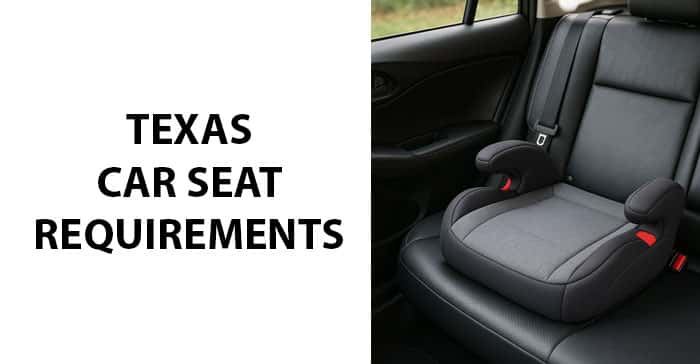
Once a child outgrows a forward-facing seat—usually when they hit the seat’s height or weight limit—Texas law requires them to use a booster seat, as long as they are under age 8 and under 4’9” in height.
Key points about booster seats:
- They must be belt-positioning boosters, meaning the vehicle’s lap and shoulder belt is used to secure the child.
- The booster seat must be used until the child is tall enough for a standard seat belt to fit properly, typically about 4’9” tall, which often occurs between ages 8 and 12.
- Even after switching to a booster or seatbelt, it remains safest for children under 13 to ride in the back seat, per safety experts and Texas guidance.
When to Switch from a Car Seat to a Booster (and Booster to Seat Belt) in Texas
Because laws depend partly on height and seat manufacturer guidelines, there’s no “one size fits all” age at which to switch seats. Instead:
- From rear-facing to forward-facing car seat: Once the child outgrows the rear-facing seat’s height or weight limit, even if under age 2.
- From a forward-facing car seat to a booster: Once the child outgrows the car seat (per height/weight), and is still under 8 years old and under 4’9″.
- From booster to seat belt: Once the child reaches about 4’9” in height, and the standard adult seat belt fits correctly (lap belt across upper thighs, shoulder belt across the shoulder and chest).
Even after a child qualifies for a seatbelt, many experts recommend continuing to ride in the back seat until at least age 13, because the back seat is generally safer for children.
Texas Seat Belt Laws (General for Everyone)
In addition to child safety seat laws, Texas law mandates seat belt use for virtually all passengers and drivers in a vehicle equipped with seat belts.
Important details:
- All drivers and passengers must wear seat belts if the vehicle is equipped with them.
- Passengers under age 17 who are no longer required to use a child safety seat or booster must use a seat belt.
- For the belt to protect properly, the lap belt must lie across the upper thighs (not crossing the neck or face). Never tuck the belt under the arm or behind the back.
Penalties and Tickets
Failing to follow Texas car seat or seat belt laws can result in fines and legal consequences.
Here’s how violations are typically penalized:
- Under Texas Transportation Code 545.412, if a child under age 8 (and under 4’9”) is not in a proper child safety seat system, the driver can be fined between $25 and $250 (misdemeanor).
- For adults or passengers over the child-safety seat requirement, failing to wear a seat belt can result in a fine of $25-$50.
- If the violation involves a minor (e.g., allowing a child to ride unrestrained), fines can increase, often $100-$200.
- For child seat violations specifically, a ticket can be as much as $250 plus court costs.
It’s important to note that in many cases, it is the driver who is responsible, even if the child is not their own.
Beyond fines, misuse (or lack) of restraints can have serious safety consequences. The state promotes regular use of safety seats and offers free car seat inspections through TxDOT to ensure proper installation.
Safety and Best Practices
According to TxDOT, motor vehicle crashes remain one of the leading causes of injury and death for children.
Some key safety recommendations from the state:
- Use a car seat or booster seat that is appropriate for your child’s size (age/weight/height) and always follow the seat manufacturer’s installation and harness instructions.
- Keep children in each stage (rear-facing, forward-facing, booster) as long as possible until they clearly meet the requirements for the next stage.
- Whenever possible, have children under 13 ride in the back seat.
Car Seat Requirements in Texas: Summary & Conclusion
Texas law mandates that all children under age 8, unless they are 4’9” or taller, must ride in an appropriate safety seat (car seat or booster seat). Infants should ride rear-facing seats until they outgrow them, and then belt positioning boosters until they are tall enough for an adult seat belt to fit properly (around 4’9”).
All drivers and passengers must wear seat belts if available, and adults are responsible for ensuring children are properly restrained. Failure to comply with these laws can result in fines, typically $25-$250 depending on the offense, and court costs.
More importantly, following these laws and going beyond the minimum by keeping children restrained in each appropriate stage “as long as possible” can dramatically increase safety and reduce the risk of serious injury or death in a crash.
When safety matters most, Tipton Ford is the perfect place to shop for your next vehicle. Our dealership offers a range of Ford models known for exceptional protection and reliability, including the Ford Explorer, Ford Edge, and Ford F-150. These vehicles are built with advanced safety technology such as collision-avoidance systems, stability control, and strong crash-test performance to help keep drivers and passengers secure. By focusing on vehicles that prioritize safety without sacrificing comfort or capability, we at Tipton Ford make it easy to choose a car you can feel confident driving every day. We serve customers in Harlingen, Weslaco, and San Benito, as well as customers from Austin and Houston. Plus, we can help you with all of your auto repair and maintenance needs, including brake repair, tires, windshield repair, and transmission repair.
0 comment(s) so far on The Guide To Car Seat Requirements in Texas