


The Guide To Texas Tire Laws & Requirements
Key Takeaways
-
Texas tire laws still focus on safety, even though most routine vehicle safety inspections are no longer required. Drivers now pay a $7.50 inspection replacement fee at registration, and some counties still require emissions testing.
-
Tires must have at least 2/32 of an inch of tread depth and be free from visible damage like exposed cords, bulges, deep cracks, or tread separation. On dual-wheel vehicles, both tires in each set must meet all requirements.
-
Tires that stick out past the fender may require proper coverage like fenders or mud flaps to prevent debris from hitting other vehicles. Mud flaps must be correctly sized and positioned, especially on lifted or modified trucks.
-
Texas has no specific tire age limit, but visibly deteriorated tires can still be considered unsafe. Keeping tires in good condition helps avoid tickets, registration issues, and safety risks on the road.
If you drive in Texas, you’re already familiar with the basic rules that come with owning a vehicle, even as some laws change. Texas tire laws are one of those things a lot of drivers don’t think about, especially now that routine safety inspections aren’t required for most personal vehicles. In this article, we’ll go over the tire inspection process as well as what’s needed for mudflaps, chains, age limits, and penalties for driving with unsafe tires.
Brownsville Tire ShopTexas Car Sales Tax
Texas Tire Laws
Texas tire requirements are still centered on keeping vehicles safe, even with changes to the registration process in January of 2025. When you renew your registration, you now pay a $7.50 inspection replacement fee that helps support statewide safety programs.
While routine safety inspections are no longer part of registration, emissions testing is still required in certain parts of the state. In those counties, vehicles need to pass an emissions test before registration can be completed. Keep in mind that tire conditions will likely still be evaluated during that process or during traffic stops if a tire appears unsafe.
Texas counties that still require emissions testing include:
- Houston area: Harris, Fort Bend, Brazoria, Galveston
- North Texas: Dallas, Tarrant, Collin, Denton, Ellis, Johnson, Kaufman, Parker, Rockwall
- Austin area: Travis, Williamson
- West Texas: El Paso County
Texas Tire Inspection Process
- Tires are inspected visually first to check overall condition, including obvious damage or signs that the tire is unsafe to operate.
- Tread depth must be measured using a tread depth gauge calibrated in 32nds of an inch if tread wear indicators are not present.
- A tire is not considered safe until it meets both the visual condition standards and the tread depth requirements set by the state.
- Spare tires are not part of the inspection, so they are not required to meet inspection standards.
- All tires must appear properly inflated, even though inspectors are not required to use a pressure gauge.
- Tread depth rules apply to both tires on each side of a vehicle with dual wheels, not just one of them.
- All other tire inspection requirements also apply to both tires in each set of dual wheels, with no exceptions.
What Makes a Tire Illegal or Unsafe in Texas
Tire rules in Texas are designed to make sure your tires can handle real driving conditions, especially wet roads. The state requires a minimum tread depth of 2/32 of an inch across the tire, which is the point where traction and water displacement drop off fast. Once tread falls below that level, tires are much more likely to slip or hydroplane, even at normal speeds, and can quickly become a safety issue.
Tires can also be rejected based on overall condition, not just tread depth. Visible cords, bald or uneven wear, tread separation, deep cuts, cracks, bulges, or knots are all grounds for rejection. Tires that look underinflated, show impact damage, or are improperly mounted may also be considered unsafe, even if some tread remains.
For vehicles with dual wheels, the standards are stricter. Both tires in each dual wheel set must meet tread depth and condition requirements. If one tire in the pair fails to meet state standards, the entire set is treated as noncompliant. This can lead to a ticket or cause registration issues if the problem isn’t fixed.
Texas Laws On Tires Sticking Out
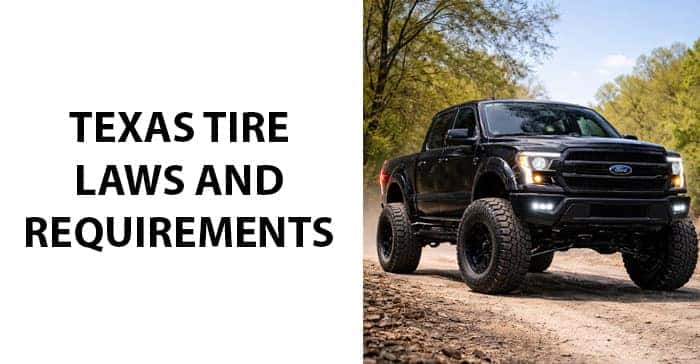
Texas laws on tires sticking out are really about common-sense safety, not nitpicking how your vehicle looks. When tires extend past the fender or body, they can kick up rocks, mud, and road debris that end up hitting other vehicles. That is why Texas generally expects tires to be covered by fenders or mud flaps that help keep that spray under control. This comes up most often with lifted trucks or wider aftermarket tires, especially when upgrades are done without thinking about street use.
If an officer notices your tires sticking out too far, it can lead to a traffic citation. Fines vary by location and circumstances, but they typically range as high as $200. In some cases, it may be treated as a fix-it issue, where correcting the problem and showing proof can reduce or clear the ticket.
Texas Mudflap Laws
Mudflap laws focus on how much protection your vehicle provides to drivers around you, not just how it looks. Vehicles with higher ground clearance or wider tires often need mud flaps to control debris kicked up from the road. Texas requires mud flaps to be properly sized and positioned so they reduce spray, rocks, and dirt, especially on trucks and modified vehicles.
Texas Tire Chain Laws
Texas tire chain laws are pretty relaxed, mostly because winter weather isn’t a common occurrence here. There’s no statewide rule that says you have to carry or use tire chains, and most Texas drivers will never need them.
Chains are generally fine when roads are icy or snowy, which usually only happens during rare winter storms. Using them on dry pavement, though, can damage the road and cause problems if you get stopped. Tire chains in Texas are more of a once in a blue moon thing than something you plan for year to year.
Tire Age Limit Laws
There’s no specific tire age limit written into state law, which surprises a lot of drivers. No rule says tires must be replaced after a certain number of years just because of age alone. That said, tire age can still matter. A tire that is dry-rotted, cracked, or clearly deteriorating can be flagged as unsafe, even if the tread looks fine. Most tire manufacturers recommend replacing tires around six to ten years old, and inspectors often use visible condition as the determining factor.
Texas Tire Laws Conclusion
Tires can be so easy to overlook, but they play a major role in how safe your vehicle really is. From a dealership perspective, this is exactly where stopping by Tipton Ford in Brownsville makes sense. Whether you’re already here for service, shopping for a vehicle, or just want advice you can trust, our team can look over your tires, explain what’s compliant, and help you avoid surprises on the road. We serve customers in McAllen, Weslaco, and Mission, as well as customers from San Antonio and Dallas. Plus, we can help you with all of your auto repair and maintenance needs, including brake repair, oil changes, windshield repair, and transmission repair.
0 comment(s) so far on The Guide To Texas Tire Laws & Requirements